
Description
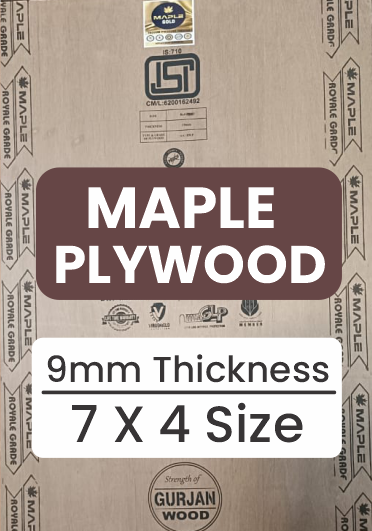
Maple Plywood
09 mm Thickness +/- 1mm
7′ X 4′ Size
IS 710 Grade
Boiling Water proof Plywood
Maple Plywood Products occupy an Viable Position In Today’s Global Market & Have multifarious applications which are versatile, Ready to use and Invincible choice for all Seasons. Atlas Plywood has Taken Upon itself the Critical Task of Satisfying the creative needs of Interior Designers, Architects, Carpenters & Furniture Manufacturers.
Technical Specifications.
Specific Gravity – 0.7 to 0.75 gm/cc
Bending Strength Kg/Sq.cm – Above 400 Kgs/Sq.cm
Screw Holding Strength – Above 250 Kgs
Nail Holding Strength – Less Than 60 Kgs
Swelling in Water – Less than 1%
Tensile Strength – 600 Kg/sq.cm
Moisture Content – 8-12%
Right Plywood For Right Purpose
Cupboards. Cabinets. Tables. Floors. Panels. You can use plywood for all of these and much more. That’s because it is one of the most flexible and adaptable products. It can play a significant role in making your home or office not just functional, but durable as well.
Manufacturing Process Of Plywood
Maple plywood is manufactured through a multi-step process that transforms hardwood logs into strong and versatile panels. Here’s a breakdown of the typical manufacturing process:
Timber Selection and Preparation:
High-quality hardwood logs, such as eucalyptus, birch, oak, or maple, are carefully selected based on the desired strength, appearance, and application of the final plywood. Sustainable sourcing is increasingly important.
The logs are debarked using high-pressure water jets or grinding wheels to remove the outer bark without damaging the wood.
Debarked logs are then cut into shorter, manageable lengths called blocks, according to the required veneer dimensions.
2. Veneer Production:
The hardwood blocks are often heated (steamed or soaked in hot water) to soften the wood, making it easier to peel.
A rotary lathe is used to peel thin layers of wood, called veneers, from the rotating log. The lathe has a long blade that shaves off continuous sheets of veneer.
For decorative, high-quality veneers, a veneer slicer might be used instead of a lathe. This method produces thinner veneers with different grain patterns.
The thickness of the veneers typically ranges from 1mm to 3mm.
3. Veneer Drying:
The freshly peeled veneers have a high moisture content, which needs to be reduced to prevent warping, fungal growth, and ensure proper bonding with adhesives.
Veneers are passed through large industrial dryers where hot air circulates to remove excess moisture, aiming for a moisture content of around 6-10%.
4. Veneer Sorting and Grading:
Dried veneers are inspected and sorted based on their quality, appearance (grain, color, knots), and size.
Higher-grade veneers with fewer defects are typically used for the face and back of the plywood panel, while lower-grade veneers can be used for the core layers. Defects like open knots might be repaired by plugging in wood patches, and splits can be filled.
5. Gluing:
A suitable adhesive is applied to the surfaces of the dried and graded veneers. Common adhesives include:
Urea-formaldehyde (UF): Used for interior-grade plywood.
The adhesive is spread evenly using glue spreaders, curtain coaters, or spray systems.
6. Layup and Pressing:
The veneers are stacked in layers, with the grain direction of each layer oriented perpendicular to the adjacent layers. This cross-graining provides the plywood with its characteristic strength and dimensional stability.
The number of layers (plies) determines the thickness of the plywood. Hardwood plywood typically has an odd number of plies to ensure symmetry and minimize warping.
The stacked veneers are then pressed under high pressure and often heat in a hot press. This process compresses the layers, spreads the glue evenly, and cures the adhesive, creating a strong bond between the veneers. Press temperatures for hardwood plywood usually range from 107°C to 135°C (225°F to 275°F), and press times vary depending on the wood species, resin type, and panel thickness.
Sometimes, a cold press is used before the hot press to initially bond the veneers.
7. Trimming and Sanding:
After pressing, the plywood panels are trimmed to the desired dimensions to ensure square edges and remove any excess material.
The surfaces of the plywood are then sanded using industrial sanders to achieve a smooth finish, making them suitable for painting, varnishing, or lamination. The amount of sanding depends on the grade of the plywood.
8. Finishing
For some applications, a face veneer of a higher-quality hardwood species might be overlaid onto the base plywood to enhance its appearance. This is done by gluing and pressing the face veneer onto the panel.
Other finishing processes may include applying stains, varnishes, or laminates.
9. Quality Control and Grading:
The finished plywood panels undergo a quality inspection to check for defects such as voids, delamination, uneven sanding, or bonding issues.
Based on the quality and appearance, the plywood is graded according to industry standards.
10. Packaging and Dispatch:
Finally, the plywood panels are packaged for protection during storage and transportation and then dispatched to customers.
The specific steps and machinery used can vary slightly depending on the manufacturing plant and the type of hardwood plywood being produced. Hardwood plywood is valued for its strength, stability, and aesthetic appeal, making it suitable for a wide range of applications in furniture making, cabinetry, construction, and interior design
Trending Key Words
Top Trending Keywords
Premium Plywood | commercial Plywood | wholesale plywoods | Laminates | Furnitures | Plywoods & Blockboards | Greenply | Century Plywood | Marino Laminate | Interior Design | Everest Plywood | Saburi plywood | Carpenter Work | Royal Touch Laminates | Century Sainik 710 Grade | Waterproof Plywood | Carpenters | Applicators | Paint Tools | Tapes | wholesale Laminates | Household Cleaning | Plywood & Blockboard | Engineered Board | Laminates | Edgeband | Cabinet Hardware | Door Hardware | Kitchen Hardware | Glass Fittings & Hardware | Wardrobe Sliding Fittings | Other Hardware | Curtain Hardware | Signs | Fasteners | Ropes | Power Tools | Hand Tools | Power Tools Accessories | Garden Tools | Safety Equipment | Ladders | Power Tools Spares | Wires & Cables | Switches and Sockets | Batteries & Torch | Circuit Breakers | Distribution Boards | Conduit, Boxes & Fitting | Electrical Tools & Accessories | Home Automation | Power Generation & Transformers | Water Treatment | Safety Detectors & Fire Extinguishers | Geysers | Light Bulbs | Ceiling Lights | Fan | Outdoor Lighting | Decorative Lights |Bath Faucets | Toilets | Wash Basins | Bath Accessories | Bath Mirrors | Bath Cabinets | Spares & Fittings | Dispensers | Pipes | Fittings | Pumps | Tanks | Tapes, Adhesives and Cleaners | Accessories | Kitchen Faucets | Kitchen Sinks | Kitchen Appliances
